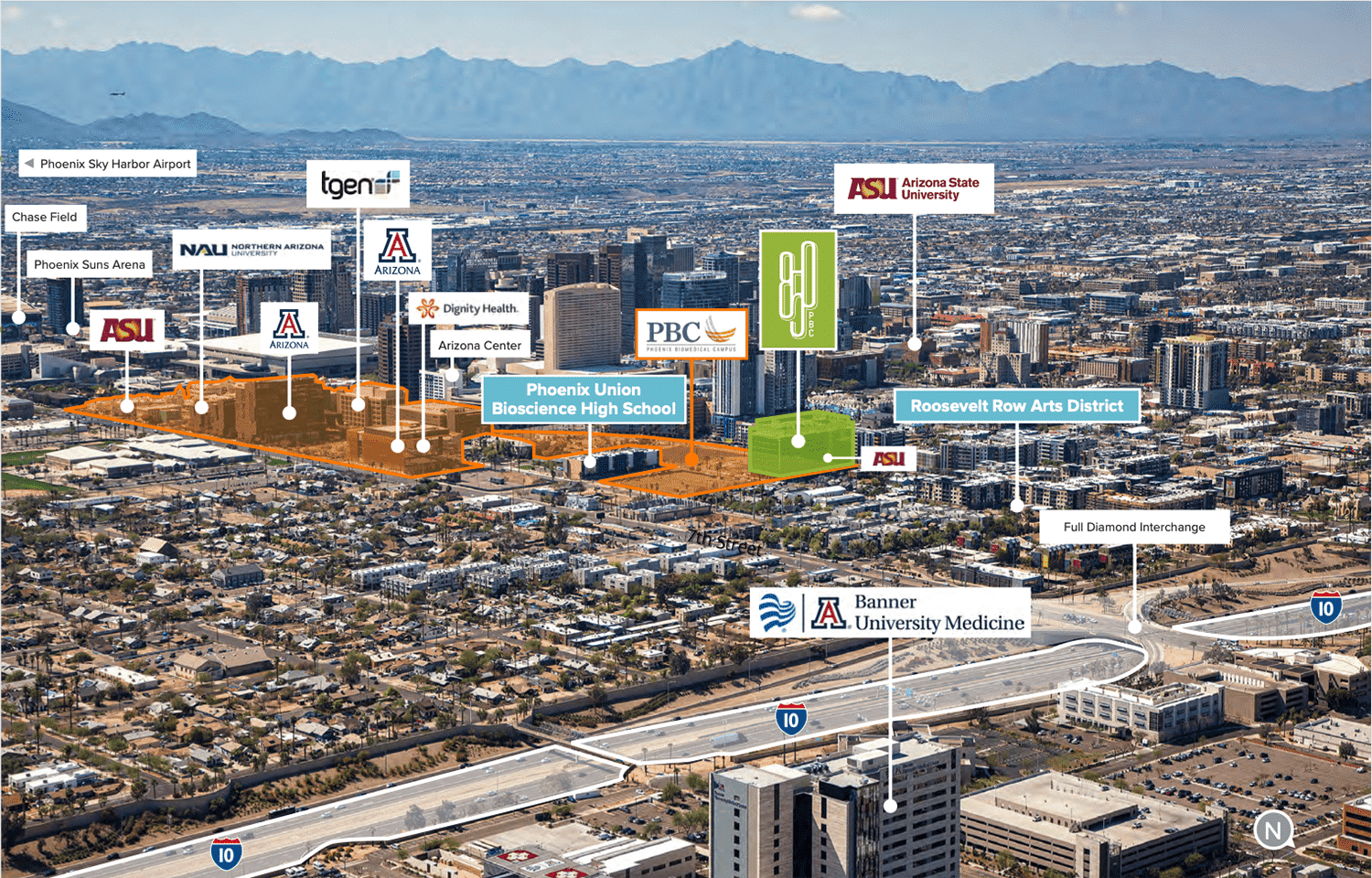
Wexford sits on the northern end of where pedestrians converge on Roosevelt Row for First Fridays. In the last decade, residential developments have slowly filled in the privately-owned land around the PBC. Since its opening, the front patio has been used for a variety of functions, from private events, to coffee bars and live music. It’s part of a larger, concerted effort to engage with the community around them.
“When we were working with Wexford at the very beginning that was one of the things they really wanted, was to be close to the arts district because there’s a lot of great synergy that happens between the creative minds and the sciences,” said Claudia Whitehead, the bioscience healthcare program manager at the City of Phoenix. “They’re very cognizant to partner with the community and invite people in.”
Presently, empty city lots represent placeholders for the buildings soon to be constructed under the Phoenix Bioscience Core masterplan. A tall Clayco crane from a nearby construction site points south to where the remaining university research buildings will be erected. This process will occur over the next 15 years, according to Whitehead.
The Future
One of the PBC’s exciting recent developments is the arrival of OncoMyx Therapeutics, a company, which true to its name, is developing an immunotherapy modified from an oncolytic virus that stimulates the immune system to target cancers.
The oncolytic virus, myxoma, is a type of virus widespread in the environment that can only infect specific breeds of rabbit, and otherwise is harmless. When researchers introduced it into laboratory animals infected with cancerous cells, it killed these growths. Moreover, the virus was found to be unharmful to humans and animals because it has never been able to cause disease in any organism outside of rabbits.
With local roots at ASU Tempe, Mayo Clinic and SkySong, the innovation immunotherapy attracted $25 million in initial private funding, including from Boehringer Ingelheim Venture Fund, the funding arm of one of the world’s largest pharmaceutical companies.
The first stage of funding dictated what cancerous formations the oncolytic virus should attack, in this case gastrointestinal, blood cancers and tumors. The second round of $50 million in private funding is going toward human trials by 2023, according to Dr. Steve Potts, the CEO and cofounder of OncoMyx.
“One thing we ask ourselves in the pre-clinical stage is, ‘What cancers can we go after? Should we think about lung cancer, colon cancer, breast cancer, blood cancers?” Potts explained. “And that is an important question because if you pick a cancer that doesn’t have a lot of responses, it hinders your work. So you try your best to look at the experiment and that’s tricky in immunotherapy because the immune system is so complex.”
As soon as 850 PBC was open for business, OncoMyx became one of the first tenants in the building. A handful of local and remote employees have the mobility to travel from airport to boardroom in about 10 minutes, working in a state-of-the-art biological lab with active collaboration with key local partners.
“What we’re definitely showing is that you can build a world-class biotech company outside the three big hubs and be successful,” Potts said.
The seven private companies in the 850 PBC — four of which are spinoffs from either ASU or UArizona — are companies on the cutting edge of tomorrow’s research and therapies. A company called ElectraTect is developing tools to measure marijuana consumption, while Calviri is a cancer vaccine company using errors in the body’s own immune response to respond to cancer. BacVax, a company incubated at the nearby College of Medicine, develops vaccines against bacterial infections in the building.